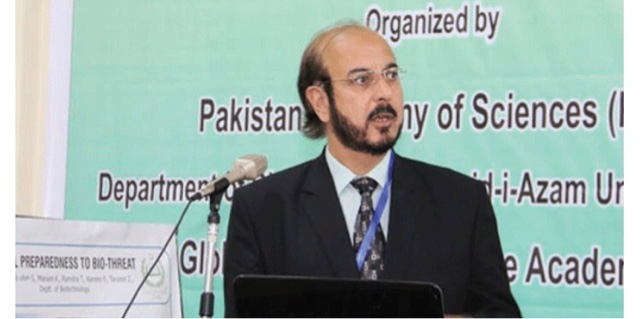
US and Pakistan Academies of Sciences got financial resources to work on “Global One-Health Fellowship program” Thailand declaration.

The world today is highly interconnected, where people, animals, vectors, and the pathogens they carry or transmit – are only an airplane flight away from any point on the globe. In addition, the interface between humans and animals is ever changing, due to crowding, commerce and agricultural intensification, human encroachment on previously undisturbed habitats and animal encroachment on the human habitat.

These factors create a perfect environment for the rapid spread of zoonotic diseases. Recent outbreaks of these diseases, such as SARS, Ebola, Middle East Respiratory Syndrome, avian influenza, Bovine Spongiform Encephalopathy, and Nipah, have caused major human suffering, enormous economic cost. Beyond infectious diseases, climate change and toxic environmental exposures threaten both human and animal populations. There is an urgent need for innovative disease control and prevention efforts that address linkages between environmental change and human and animal health in an integrated, “One Health” (1-H) manner.
Nurturing these sorts of connections among countries and building up inter-disciplinary cadres of skilled and trained individuals at the country level takes time and resources.
In this spirit, a meeting hosted by the United States National Academy of Sciences (US-NAS) and Pakistan Academy of Sciences in Thailand invited experts from different countries and decided to undertake a fellowship program to build capacity of early to mid-career scientists from Pakistan in One Health (1-H) and foster collaboration and cooperation in preparedness and response to zoonotic diseases and other shared environmental health risks.
 Specifically, the fellowship program is designed to:
• Create a model for fostering enduring international and national research collaborations that could be adapted and applied in different country settings;
• Pilot this model as a first step to building a 1-H research network in Pakistan;
• Provide a forum for discussion and debate regarding 1-H issues including: legal/regulatory structures, ethical issues, and pedagogy for teaching 1-H as part of an academic curriculum.
The future Fellows and host institutions participating in this program have the opportunity to help shape a model that may serve multiple geographies and develop a stronger global 1-H community. The USNAS & PAS envisions this model to be a platform in which direct country-to-country collaboration is fostered among 1-H practitioners seeking new knowledge and among institutions with skills and capacity to share.