Showing posts with label Moeed Pirzada. Show all posts

Saturday, March 14, 2015

All Stakeholders Need to Join Hands to Improve Quality of Life in Pakistan.

All Stakeholders Need to Join Hands to Improve Quality of Life in Pakistan.

Future socio-economic well being can only be ensured if business entities, government institutions, media and communities work towards creating shared values.


Islamabad, PK – 14 March 2015 - Creating value for the citizens by engaging communities in the process of business, transparency and accountability was discussed today at a roundtable dialogue at Marriott Hotel in Islamabad organized by AGAHI. The roundtable discussion on how organizations can create value for their stakeholders focused on the future of corporate social responsibility and public relations in Pakistan. The dialogue brought together the journalists’ community and the corporate sector to explore the scope of Creating Shared Value (CSV) in promoting socio-cultural norms, protection of socio-geographic environment and ethic-driven business practices, sharing government responsibilities, and ensuring transparency in managerial practices in Pakistan. The speakers and the participants shared the challenges their organizations faced ensuring the Corporate Social Responsibility (CSR) and Public Relations (PR) vision while meeting the profit bottom line.
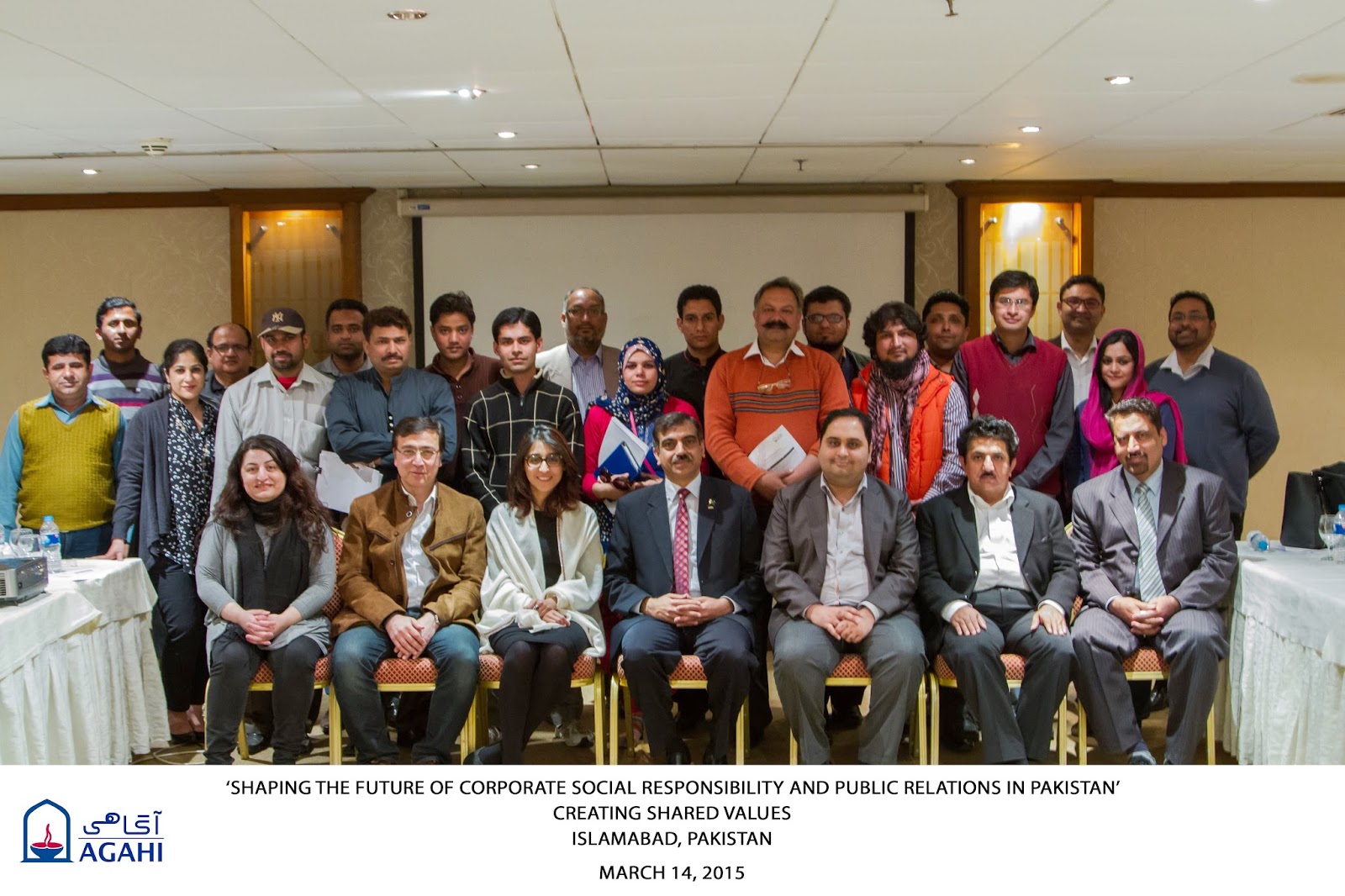


Puruesh Chaudhary, Founder & President AGAHI, said that the dynamics within which the businesses are operating in are evolving at an incredible pace; drivers of change being innovation and technology. The philosophy that is re-determining the functions of communications for socio-economic and improvements in human condition is a collective responsibility of all stakeholders. She further added that, “creating shared value as a separate category for the Agahi Awards - Beyond 2015 is a reason to highlight journalistic efforts for assembling information and knowledge on corporate social responsibility, social entrepreneurship, dignity, interfaith, and media ethics.” 


All profitable businesses are conducted in an environment, which impacts the entire value chain processes, caring for customers and other stakeholders is a good business practice, said Waheed Hamid, Director Communications at Fauji Fertilizers Company Limited (FFC). He further said, collaboration between public and private businesses could do wonders for the community. Public Relations is no more a relationship enhancement exercise, it is more of an understanding of others point of view and realigning business strategy for mutual gains for not only the businesses but also for the society they operate in. 

Corporate social responsibility (CSR), is also called referred to as corporate conscience, corporate citizenship or sustainable responsible business. This is a form of corporate self-regulation integrated into a business model. CSR policy functions as a self-regulatory mechanism whereby a business monitors and ensures its active compliance with the spirit of the law, ethical standards and international norms.

Creating shared value (CSV) is a business concept first introduced by Prof. Michael E. Porter, a leading authority on competitive strategy and head of the Institute for Strategy and Competitiveness at Harvard Business School, and Mark R. Kramer, Kennedy School at Harvard University and co-founder of FSG.

"The future prosperity for society lies in creating common shared values for all stakeholders collectively, businesses and government need to cater and ensure socio-economic dividends for their respective communities and clientele", said Amir Jahangir, Young Global Leader World Economic Forum.


Senior strategic communication expert, Hina Akhtar said that, many see CSR as a PR tool but if you look at it from a broader perspective, CSR is a commitment to operate as a responsible business entity, whereas a business’s primary objective is to gain financial profits, a responsible organization measures its success beyond these financial gains.

Colonel (R) Waheed Hamid, Director Communications Fauji Fertilizers Company (LTD), Hina Akhtar, Chief Executive Officer, Gold String Communications, Imran Sheikh, Educationist, Executive Vice President JS Bank, Dr. Ansir Ali Rajput Educationist and Amir Jahangir, Young Global Leader of the World Economic Forum shared their views the benefits and challenges of engaging communities and other stakeholders for good business practices. A large number of business and economic journalists also attended the round table discussion.


AGAHI is a not for profit organization established in Islamabad in 2011 under the Society Registration Act 1860. Its primary function is to create non-paid communication strategies, content intelligence structures, development collateral and tools for diverse sectors and organizations. AGAHI encourages and advises individuals and institutions in pursuing and supporting initiatives to improve the state of development in Pakistan. It works on developmental frameworks facilitating information and knowledge sharing platforms on understanding challenges in global perspective. Its research work mainly focuses on national and international security, ICT, competitiveness, human capital development, and governance. AGAHI in association with several leading national and international partners focuses on creating shared spaces for interactive learning, collaborative thinking, and knowledge sharing. AGAHI is at the forefront of devising foresight research and future scenarios work in Pakistan.


This year AGAHI, celebrates AGAHI AWARDS – Beyond 2015 by recognizing best reporting practices on categories such as: Business & Economy (Competitiveness), Creating Shared Value, Disaster and Catastrophe, Education, Gender, Health, Youth Empowerment, Human Rights, Infotainment, Innovation Journalism, Judiciary, Millennium Development Goals, Journalism for Peace, Photo Journalism, Entrepreneurship, Sports, Energy, Water, Agriculture, Environment, Foreign Policy, Foresight and Futures. businesses are operating in are evolving at an incredible pace; drivers of change being innovation and technology. The philosophy that is re-determining the functions of communications for socio-economic and improvements in human condition is a collective responsibility of all stakeholders. She further added that, “creating shared value as a separate category for the Agahi Awards - Beyond 2015 is a reason to highlight journalistic efforts for assembling information and knowledge on corporate social responsibility, social entrepreneurship, dignity, interfaith, and media ethics.”

Saturday, November 30, 2013

Media Credibility Index launched in Pakistan

Media Credibility Index launched in Pakistan


 Media Credibility Index launched in Pakistan.

4E6A1065


Media Credibility Index aims to assess current affairs programming; ranking content and delivery mechanisms across six pillars of credibility.

The CredibilityLab at Mishal Pakistan launched the Media Credibility Index (MCI), an initiative started in January 2013 in collaboration with Pakistan Coalition for Ethical Journalism, leading research and academic institutions, and media practitioners. The launch ceremony was held in Islamabad where prominent media professionals, representatives of regulatory bodies, media development organizations and members of the civil society participated. The Index focuses on the relative credibility and believability of various media channels through which content is created.
Addressing the participants, Founder and Director, Ethical Journalism Network, Aidan White said that launch of the Media Credibility Index is a landmark moment for media accountability in Pakistan. In a country where people are overwhelmed by a torrent of information on all sides, and where corruption lurks in all areas of public life, the greatest challenge facing journalists and media professionals is to produce information that is reliable, useful and above all truthful.
The MCI provides fundamentals for analyzing media discourse in the country. By using benchmarks provided by professionals at national and international level, the MCI provides an opportunity to examine how the news analysis and commentary of high profile news anchors contribute to better understanding of complex issues in Pakistan’s robust landscape of journalism and politics, he further added.
Speaking at on the occasion, Dr. Nazir Saeed, Federal Secretary for Information, Broadcasting and National Heritage said, “Television has an overwhelming impact on peoples’ decision-making power. The significance of the Media Credibility Index is in its use and ability to highlight content that can empower both the newsmakers and the information seekers; enabling them to create an effective knowledge ecosystem in the country. MCI has the potential of becoming the source for an informed decision making tool in public policy debate. MCI will promote ethical content practices in the country, information that tells stories not just about the powerful, but also about the powerless, and not just about the life of the decision makers, but also about issues concerning the masses”.
“I feel proud of the fact that the Media Credibility Index has been launched in Pakistan and can be a benchmark for other countries in the world for promoting, balanced, ethical and fair journalism practices”, said Dr. Nazir Saeed.
Center for International Media Ethics (CIME) Ambassador for Pakistan, Puruesh Chaudhary said that the index has been developed after an extensive examination of media laws, ethical principals drafted by different media groups, compliance regulations formulated by regulatory bodies and journalistic organizations. The MCI will explore the state of media in Pakistan against six indicators and 20 sub-indices. The results are currently being published on a weekly basis on the Media Credibility Index website as well.
Senior journalist and founder, Pakistan Coalition for Ethical Journalism, Muhammad Ziauddin said that Mishal has incorporated more than thirty code of conducts, principles of ethical journalism, which include currently prevalent seven national code of conducts and twenty four international code of ethics from international regulatory bodies, which have been agreed upon across the globe. He further said, that the codes of ethics framed by the Pakistani media groups have also being included within the index, these entail Jang group’s Geo Asool, Dunya’s code of ethics, Express group’s journalism code of conduct and Dawn Group’s principles and code of conduct.
After reviewing the principles of journalism and codes of ethics for journalists; six media credibility indicators with 20 sub-indices have been developed in order to assess the media discourse and credibility of current affairs anchors in Pakistan. This extensive study entails thirty-five current affairs programming of the mainstream Pakistani news channels. The Credibility of the anchors and content discourse is being assessed on; Professional Competence, Ethics, Accuracy, Balance, Timeliness and Fairness.
Chief Executive Officer, Mishal Pakistan, Amir Jahangir said the CredibilityLab, through its activities will further strengthen the Triple Helix concept, which relies on three main ideas: (1) a more prominent role for the University in creating new though and research processes, bringing them on par with the Industry and Government that form the basis of a Knowledge Society; (2) a movement toward collaborative relationships among the three major institutional spheres, in which information and knowledge policy is increasingly an outcome of interaction rather than a prescription from the Government; (3) in addition to fulfilling their traditional functions, each institutional sphere also “takes the role of the ‘other’ performing new roles as well as their traditional function.
The CredibilityLab at Mishal will be publishing its research on the state of media and competitiveness in Pakistan in collaboration with its partners. The MCI research has been one of the few initiatives in Pakistan, where research work has been collaborated with eleven academic partners in the country, including University of the Punjab, International Islamic University, Fatima Jinnah Women University, Lahore College for Women University, University of Gujrat, Government College University Faisalabad, Islamia University Bhawalpur, University of Balouchistan, Greenwich University and Bharia University.
Mishal Pakistan is the partner institute of the Global Competitiveness and Benchmarking Networks, World Economic Forum. Mishal assists the forum in creating the soft-data on Pakistan, identifying Pakistan’s competitiveness challenges. Mishal has also launched Pakistan’s first journalism awards “AGAHI Awards” on the framework designed jointly with the Center for International Media Ethics and UNESCO’s Media Development Indicators.
As a partner institute Mishal has been working closely with the World Economic Forum on measuring Pakistan’s performance on multiple international indices and reports i.e. Global Competitiveness Index, Global Gender Gap Index, Global Enabling Trade Index, Global Information Technology Report – Network Readiness Index, Financial Development Index and the Travel and Tourism Competitiveness Index.
For more information on the Media Credibility Index (MCI) please visit: www.mediacredibilityindex.com